

SC-300 Exam PDF [2024] Tests Free Updated Today with Correct 247 Questions
Microsoft SC-300 Exam Preparation Guide and PDF Download
Microsoft SC-300 is an important certification for professionals who are responsible for managing identity and access for Microsoft services. SC-300 exam is designed to test the candidate's knowledge and skills in identity and access management, and to ensure that they have a thorough understanding of the technologies and tools used in this area. Candidates can prepare for SC-300 exam by taking training courses, studying the exam objectives, and practicing with sample questions. With this certification, professionals can demonstrate their expertise in identity and access management and enhance their career prospects.
The Microsoft SC-300 exam is intended for IT professionals who are looking to advance their careers in identity and access management, and who wish to demonstrate their expertise in managing user identities and access in cloud-based environments. Passing the SC-300 exam is a prerequisite for earning the Microsoft Certified: Identity and Access Administrator Associate certification, which is a highly respected credential in the IT industry.
Microsoft SC-300 exam covers various topics related to identity and access administration in Microsoft 365 and Azure AD. These topics include managing user accounts and identities, configuring and managing authentication, implementing and managing access governance, and configuring and managing privileged access. Candidates will also be tested on their knowledge of Azure AD Connect, Azure AD Identity Protection, and Azure AD Privileged Identity Management.
NEW QUESTION # 144
You have an Azure AD tenant that contains the users shown in The following table.
You enable self-service password reset (SSPR) for all the users and configure SSPR to require security questions as the only authentication method.
Which users must use security questions when resetting their password?
- A. User4 only
- B. User3and User4only
- C. User1, User3, and User4 only
- D. User1 and User4only
- E. User1, User2, User3. and User4
Answer: B
NEW QUESTION # 145
You have an Azure Active Directory (Azure AD) tenant that contains the following objects:
* A device named Device1
* Users named User1, User2, User3, User4, and User5
* Groups named Group1, Group2, Group3, Group4, and Group5
The groups are configured as shown in the following table.
To which groups can you assign a Microsoft Office 365 Enterprise E5 license directly?
- A. Group1 and Group4 only
- B. Group1, Group2, Group3, Group4, and Group5
- C. Group1, Group2, Group4, and Group5 only
- D. Group1 only
- E. Group1 and Group2 only
Answer: E
Explanation:
Explanation/Reference:
https://docs.microsoft.com/en-us/azure/active-directory/enterprise-users/licensing-group-advanced
NEW QUESTION # 146
You have an Azure subscription.
Azure AD logs are sent to a Log Analytics workspace.
You need to query the logs and graphically display the number of sign-ins per user.
How should you complete the query? To answer, select the appropriate options in the answer area.
Answer:
Explanation:
Explanation
Box 1 =
SigninLogs
| where ResultType == 0
| summarize login_count = count() by identity
| render piechart
This query retrieves the sign-in logs, filters the successful sign-ins, summarizes the count of sign-ins per user, and renders the result as a pie chart.
Box 2 = Render
NEW QUESTION # 147
Your network contains an on-premises Active Directory domain that syncs to an Azure Active Directory (Azure AD) tenant.
The tenant contains the groups shown in the following table.
The tenant contains the users shown in the following table.
Answer:
Explanation:
NEW QUESTION # 148
You have an Azure AD tenant.
You perform the tasks shown in the following table.
On April 5, an administrator deletes App1, App2, App3, and App4.
You need to restore the apps and the settings.
Which apps can you restore on April 16, and which settings can you restore for App4 on April 16? To answer, select the appropriate options in the answer area.
NOTE: Each correct selection is worth one point.
Answer:
Explanation:
Explanation
A screenshot of a phone Description automatically generated
NEW QUESTION # 149
You have an Azure Active Directory (Azure AD) tenant that has Security defaults disabled.
You are creating a conditional access policy as shown in the following exhibit.
Use the drop-down menus to select the answer choice that completes each statement based on the information presented in the graphic.
NOTE: Each correct selection is worth one point.
Answer:
Explanation:
Reference:
https://docs.microsoft.com/en-us/azure/active-directory/conditional-access/howto-conditional-access-policy-all-users-mfa
NEW QUESTION # 150
You have a Microsoft 365 tenant.
You need to identify users who have leaked credentials. The solution must meet the following requirements.
* Identity sign-Ins by users who ate suspected of having leaked credentials.
* Rag the sign-ins as a high risk event.
* Immediately enforce a control to mitigate the risk, while still allowing the user to access applications.
What should you use? To answer, select the appropriate options in the answer area.
NOTE: Each correct selection is worth one point.
Answer:
Explanation:
Reference:
https://docs.microsoft.com/en-us/azure/active-directory/identity-protection/concept-identity-protection-risks
NEW QUESTION # 151
You have an Azure Active Directory (Azure AD) tenant that contains an administrative unit named Department1.
Department1 has the users shown in the Users exhibit. (Click the Users tab.)
Department1 has the groups shown in the Groups exhibit. (Click the Groups tab.)
Department1 has the user administrator assignments shown in the Assignments exhibit. (Click the Assignments tab.)
The members of Group2 are shown in the Group2 exhibit. (Click the Group2 tab.)
For each of the following statements, select Yes if the statement is true. Otherwise, select No.
NOTE: Each correct selection is worth one point.
Answer:
Explanation:
Explanation
Reference:
https://docs.microsoft.com/en-us/azure/active-directory/roles/administrative-units
NEW QUESTION # 152
You need to implement password restrictions to meet the authentication requirements.
You install the Azure AD password Protection DC agent on DC1.
What should you do next? To answer, select the appropriate options in the answer area.
NOTE: Each correct selection is worth one point.
Answer:
Explanation:
NEW QUESTION # 153
You need to identify which roles to use for managing role assignments. The solution must meet the delegation requirements.
What should you do? To answer, select the appropriate options in the answer area.
NOTE: Each correct selection is worth one point.
Answer:
Explanation:
Reference:
https://docs.microsoft.com/en-us/azure/role-based-access-control/role-assignments-portal
https://docs.microsoft.com/en-us/azure/active-directory/roles/permissions-reference
NEW QUESTION # 154
You need to meet the technical requirements for license management by the helpdesk administrators.
What should you create first, and which tool should you use? To answer, select the appropriate options in the answer area.
NOTE: Each correct selection is worth one point.
Answer:
Explanation:
NEW QUESTION # 155
You have a Microsoft 365 tenant.
You need to identify users who have leaked credentials. The solution must meet the following requirements.
* Identity sign-Ins by users who ate suspected of having leaked credentials.
* Rag the sign-ins as a high risk event.
* Immediately enforce a control to mitigate the risk, while still allowing the user to access applications.
What should you use? To answer, select the appropriate options in the answer area.
NOTE: Each correct selection is worth one point.
Answer:
Explanation:
NEW QUESTION # 156
You have an Azure Active Directory (Azure AD) tenant that has Security defaults disabled.
You are creating a conditional access policy as shown in the following exhibit.
Use the drop-down menus to select the answer choice that completes each statement based on the information presented in the graphic.
NOTE: Each correct selection is worth one point.
Answer:
Explanation:
Reference:
https://docs.microsoft.com/en-us/azure/active-directory/conditional-access/howto-conditional-access-policy-all-users-mfa
NEW QUESTION # 157
Your network contains an on-premises Active Directory domain that syncs to an Azure AD tenant.
Users sign in to computers that run Windows 10 and are joined to the domain.
You plan to implement Azure AD Seamless Single Sign-On (Azure AD Seamless SSO).
You need to configure the Windows 10 computers to support Azure AD Seamless SSO.
What should you do?
- A. Enable Enterprise State Roaming.
- B. Modify the Local intranet zone settings
- C. Install the Azure AD Connect Authentication Agent.
- D. Configure Sign-in options from the Settings app.
Answer: B
NEW QUESTION # 158
You have an Azure Active Directory (Azure AD) tenant that has an Azure Active Directory Premium Plan 2 license. The tenant contains the users shown in the following table.
You have the Device Settings shown in the following exhibit.
User1 has the devices shown in the following table.
For each of the following statements, select Yes if the statement is true. Otherwise, select No.
NOTE: Each correct selection is worth one point.
Answer:
Explanation:
Explanation
Box 1: Yes
Users may join 5 devices to Azure AD.
Box 2: Yes
Box 3: No
An additional local device administrator has not been applied
Reference:
https://docs.microsoft.com/en-us/azure/active-directory/devices/device-management-azure-portal
NEW QUESTION # 159
You have an Azure Active Directory (Azure AD) tenant that has multi-factor authentication (MFA) enabled.
The account lockout settings are configured as shown in the following exhibit.
Use the drop-down menus to select the answer choice that completes each statement based on the information presented in the graphic.
NOTE: Each correct selection is worth one point.
Answer:
Explanation:
NEW QUESTION # 160
You need to meet the planned changes for the User administrator role.
What should you do?
- A. Modify Role settings
- B. Create an administrator unit.
- C. Modify Active Assignments.
- D. Create an access review.
Answer: C
Explanation:
Role Setting details is where you need to be: Role setting details - User Administrator Privileged Identity Management | Azure AD roles Default Setting State Require justification on activation Yes Require ticket information on activation No On activation, require Azure MFA Yes Require approval to activate No Approvers None
Topic 1, Contoso, Ltd
Existing Environment
The on-premises network of Contoso contains an Active Directory domain named contos.com. The domain contains an organizational unit (OU) named Contoso_Resources. The Contoso_Resoureces OU contains all users and computers.
The Contoso.com Active Directory domain contains the users shown in the following table.
Microsoft 365/Azure Environment
Contoso has an Azure AD tenant named Contoso.com that has the following associated licenses:
Microsoft Office 365 Enterprise E5
Enterprise Mobility + Security
Windows 10 Enterprise E5
Project Plan 3
Azure AD Connect is configured between azure AD and Active Directory Domain Serverless (AD DS). Only the Contoso Resources OU is synced.
Helpdesk administrators routinely use the Microsoft 365 admin center to manage user settings.
User administrators currently use the Microsoft 365 admin center to manually assign licenses, All user have all licenses assigned besides following exception:
The users in the London office have the Microsoft 365 admin center to manually assign licenses. All user have licenses assigned besides the following exceptions:
The users in the London office have the Microsoft 365 Phone System License unassigned.
The users in the Seattle office have the Yammer Enterprise License unassigned.
Security defaults are disabled for Contoso.com.
Contoso uses Azure AD Privileged identity Management (PIM) to project administrator roles.
Problem Statements
Contoso identifies the following issues:
* Currently, all the helpdesk administrators can manage user licenses throughout the entire Microsoft 365 tenant.
* The user administrators report that it is tedious to manually configure the different license requirements for each Contoso office.
* The helpdesk administrators spend too much time provisioning internal and guest access to the required Microsoft 365 services and apps.
* Currently, the helpdesk administrators can perform tasks by using the: User administrator role without justification or approval.
* When the Logs node is selected in Azure AD, an error message appears stating that Log Analytics integration is not enabled.
Planned Changes
Contoso plans to implement the following changes.
Implement self-service password reset (SSPR). Analyze Azure audit activity logs by using Azure Monitor-Simplify license allocation for new users added to the tenant. Collaborate with the users at Fabrikam on a joint marketing campaign. Configure the User administrator role to require justification and approval to activate.
Implement a custom line-of-business Azure web app named App1. App1 will be accessible from the internet and authenticated by using Azure AD accounts.
For new users in the marketing department, implement an automated approval workflow to provide access to a Microsoft SharePoint Online site, group, and app.
Contoso plans to acquire a company named Corporation. One hundred new A Datum users will be created in an Active Directory OU named Adatum. The users will be located in London and Seattle.
Technical Requirements
Contoso identifies the following technical requirements:
* AH users must be synced from AD DS to the contoso.com Azure AD tenant.
* App1 must have a redirect URI pointed to https://contoso.com/auth-response.
* License allocation for new users must be assigned automatically based on the location of the user.
* Fabrikam users must have access to the marketing department's SharePoint site for a maximum of 90 days.
* Administrative actions performed in Azure AD must be audited. Audit logs must be retained for one year.
* The helpdesk administrators must be able to manage licenses for only the users in their respective office.
* Users must be forced to change their password if there is a probability that the users' identity was compromised.
NEW QUESTION # 161
You have an Azure Active Directory (Azure AD) tenant that contains the users shown in the following table.
User1 is the owner of Group1.
You create an access review that has the following settings:
Users to review: Members of a group
Scope: Everyone
Group: Group1
Reviewers: Members (self)
Which users can perform access reviews for User3?
- A. User1 only
- B. User1 and User2 only
- C. User1, User2, and User3
- D. User3 only
Answer: D
NEW QUESTION # 162
You have an Azure AD tenant
You configure User consent settings to allow users to provide consent to apps from verified publishers.
You need to ensure that the users can only provide consent to apps that require low impact permissions.
What should you do?
- A. Configure permission classifications.
- B. Create an enterprise application collection.
- C. Create an access review.
- D. Create an access package.
Answer: A
NEW QUESTION # 163
You implement the planned changes for SSPR.
What occurs when User3 attempts to use SSPR? To answer, select the appropriate options in the answer area.
NOTE: Each correct selection is worth one point.
Answer:
Explanation:
Answer is
NEW QUESTION # 164
Your company has an Azure Active Directory (Azure AD) tenant named Contoso.com. The company has a business partner named Fabrikam, Inc.
Fabrikam uses Azure AD and has two verified domain names of fabrikam.com and litwarein.com Both domain names are sued for Fabrikam email addresses.
You create a connected organization for Fabrikam.
You need to ensure that the package1 will be accessible only to users who have fabrikam.com email addresses.
What should you do? To answer, select the appropriate options in the answer area.
NOTE: Each correct selection is worth one point.
Answer:
Explanation: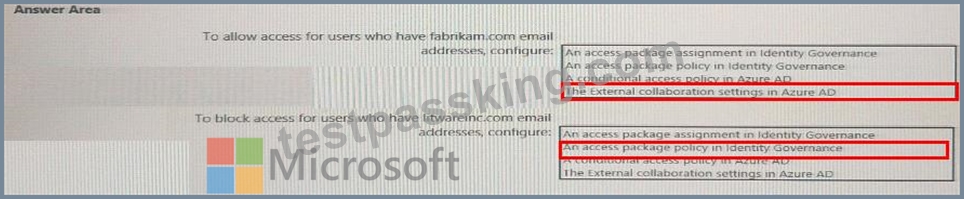
NEW QUESTION # 165
You need to meet the planned changes and technical requirements for App1.
What should you implement?
- A. Azure AD Application Proxy
- B. a policy set in Microsoft Endpoint Manager
- C. an app registration in Azure AD
- D. an app configuration policy in Microsoft Endpoint Manager
Answer: C
Explanation:
Reference:
https://docs.microsoft.com/en-us/azure/active-directory/develop/quickstart-register-app
Topic 2, Litware, Inc
Identity Environment
The network contains an Active Directory forest named litware.com that is linked to an Azure Active Directory (Azure AD) tenant named litware.com. Azure AD Connect uses pass-through authentication and has password hash synchronization disabled.
Litware.com contains a user named User1 who oversees all application development. Litware implements Azure AD Application Proxy.
Fabrikam has an Azure AD tenant named fabrikam.com. The users at Fabrikam access the resources in litware.com by using guest accounts in the litware.com tenant.
Cloud Environment
All the users at Litware have Microsoft 365 Enterprise E5 licenses. All the built-in anomaly detection polices in Microsoft Cloud App Security are enabled.
Litware has an Azure subscription associated to the litware.com Azure AD tenant. The subscription contains an Azure Sentinel instance that uses the Azure Active Directory connector and the Office 365 connector. Azure Sentinel currently collects the Azure AD sign-ins logs and audit logs.
On-premises Environment
The on-premises network contains the severs shown in the following table.
Both Litware offices connect directly to the internet. Both offices connect to virtual networks in the Azure subscription by using a site-to-site VPN connection. All on-premises domain controllers are prevented from accessing the internet.
Delegation Requirements
Litware identifies the following delegation requirements:
* Delegate the management of privileged roles by using Azure AD Privileged Identity Management (PIM).
* Prevent nonprivileged users from registering applications in the litware.com Azure AD tenant-
* Use custom catalogs and custom programs for Identity Governance.
* Ensure that User1 can create enterprise applications in Azure AD. Use the principle of least privilege.
Licensing Requirements
Litware recently added a custom user attribute named LWLicenses to the litware.com Active Directory forest. Litware wants to manage the assignment of Azure AD licenses by modifying the value of the LWLicenses attribute. Users who have the appropriate value for LWLicenses must be added automatically to Microsoft 365 group that he appropriate license assigned.
Management Requirement
Litware wants to create a group named LWGroup1 will contain all the Azure AD user accounts for Litware but exclude all the Azure AD guest accounts.
Authentication Requirements
Litware identifies the following authentication requirements:
* Implement multi-factor authentication (MFA) for all Litware users.
* Exempt users from using MFA to authenticate to Azure AD from the Boston office of Litware.
* Implement a banned password list for the litware.com forest.
* Enforce MFA when accessing on-premises applications.
* Automatically detect and remediate externally leaked credentials
Access Requirements
Litware wants to create a group named LWGroup1 that will contain all the Azure AD user accounts for Litware but exclude all the Azure AD guest accounts.
Monitoring Requirements
Litware wants to use the Fusion rule in Azure Sentinel to detect multi-staged that include a combination of suspicious Azure AD sign-ins followed by anomalous Microsoft Office 365 activity.
NEW QUESTION # 166
......
Verified & Correct SC-300 Practice Test Reliable Source May 16, 2024 Updated: https://passleader.testpassking.com/SC-300-exam-testking-pass.html